The plug-in solar system for garages, carports and garden sheds
SOLYCO SOLon as a plug-in solar system


pv magazine TOP INNOVATION Award 2024
SOLon was named a TOP INNOVATION by pv magazine in 2024.

Intersolar Finalist
The smarter E AWARD
SOLon is a finalist for The smarter E AWARD 2026 in the Photovoltaics category.

EUPD Research
Top Brand PV Modules 2026
EUPD Research named SOLYCO a Top Brand PV Modules Germany 2026.
SOLon generates power from both sides.

Conventional solar module:
only one side generates power
SOLon:
both sides generate power

13 h
instead of 8 hours solar power
13 instead of 8 hours of solar power output, on a regular April day, compared with a 45° east-facing roof.*
3 ×
more productive in the afternoon
From 2 pm onwards, averaged over the whole year, SOLon delivers three times as much power as the east-facing roof.
1,7 ×
this much extra yield from the second side
The rear side increases yield by a factor of 1.7. In lab measurements, it reaches 90% of the front side's output.*
+15 %
more on this day with same power
Calculated over the entire April day, at exactly the same watt-peak rating of standard PV datasheet.*
Calculated for Berlin using PVGIS weather data for the years 2019 to 2023, compared with a conventional solar module on an east-facing roof with a 45-degree pitch, at the same watt-peak rating, on 27 April*.

Super simple
Three steps to rooftop installation: Set it up, plug it in, done. Expandable almost indefinitely.
Active on both sides
The front and back are directly exposed to sunlight in the early morning and late afternoon.
Winterstrom
In winter the sun is low and delivers yield for longer. Ideal for heat pumps and electric car charging
About the scenarios: Calculated for Berlin using hourly data from the PVGIS solar data service, years 2019 to 2023. The sunny April day is 27 April 2021, the winter day 19 February 2021. Each side of the comparison has 320 watts peak: a conventional solar module on a 45° east-facing roof versus two vertical SOLon modules with their axis turned 15 degrees towards the south, 80 centimetres row spacing, on a dark bitumen membrane. "Generation hours" here means hours in which a system delivers at least a quarter of its own daily peak. The figure therefore describes duration, not quantity. All percentages refer to the daily yield of the conventional module = 100%. The output of the rear side of the SOLon module was measured separately in the lab. It is 140 Wp, 90% of the front side. The front side alone: 160 Wp.
What SOLon is built for.
-
Built for flat roofs. SOLon is rated for roof pitches up to 10°, whether on a flat roof, garage, carport, green roof or open ground. It is set down rather than screwed in, so the roof membrane is never penetrated. SOLon is not suitable for pitched roofs.
-
For anyone who needs power in the morning and evening. Heat pumps run early in the day, while cooking and charging happen in the evening, and those are exactly the hours when SOLon delivers. Its east-west orientation suits you if your consumption is spread across the day and the long morning and evening hours matter most.
-
Especially strong in winter. In our Berlin example, SOLon produces around 19% more than an east-facing roof over the winter, and as much as 21% more in December. That is because the low winter sun hits a vertical surface at almost a right angle. Over the whole winter, SOLon comes out clearly ahead of an east-facing roof, which makes it a good fit for heat pump power.
-
Is SOLon right for me? Over a full year, SOLon can't match a south-facing pitched roof. If you have little roof space and want as much output as possible around midday, flat-mounted modules are the better choice. SOLon plays to its strengths where there is no south-facing pitch anyway, on a flat roof, and where power is needed in the morning and evening or especially in winter.
Do I have to drill into the roof?
No. SOLon is neither screwed down nor glued, so the roof membrane stays intact. The system stands on ballast feet, and the installation plan specifies how many are needed and where they go.
The wide contact surface of the feet spreads the weight and protects the roof membrane. The typical load is around 12 kg per square metre, ballast included.
This makes SOLon suitable for sensitive flat roofs too, including bitumen, synthetic membrane and green roofs. Please check the roof's load capacity before installation.


3 to 24 SOLon modules can be set up as a plug-in solution, a good fit for small flat roofs, garages and carports.

Snow settles beside the modules, not on them. That makes SOLon a strong choice when you need winter power.
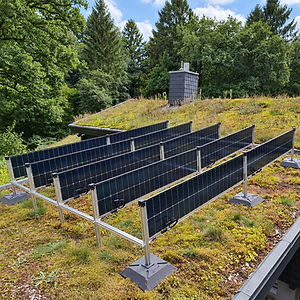
10 SOLon modules: especially useful in winter, when a heat pump needs a lot of power.